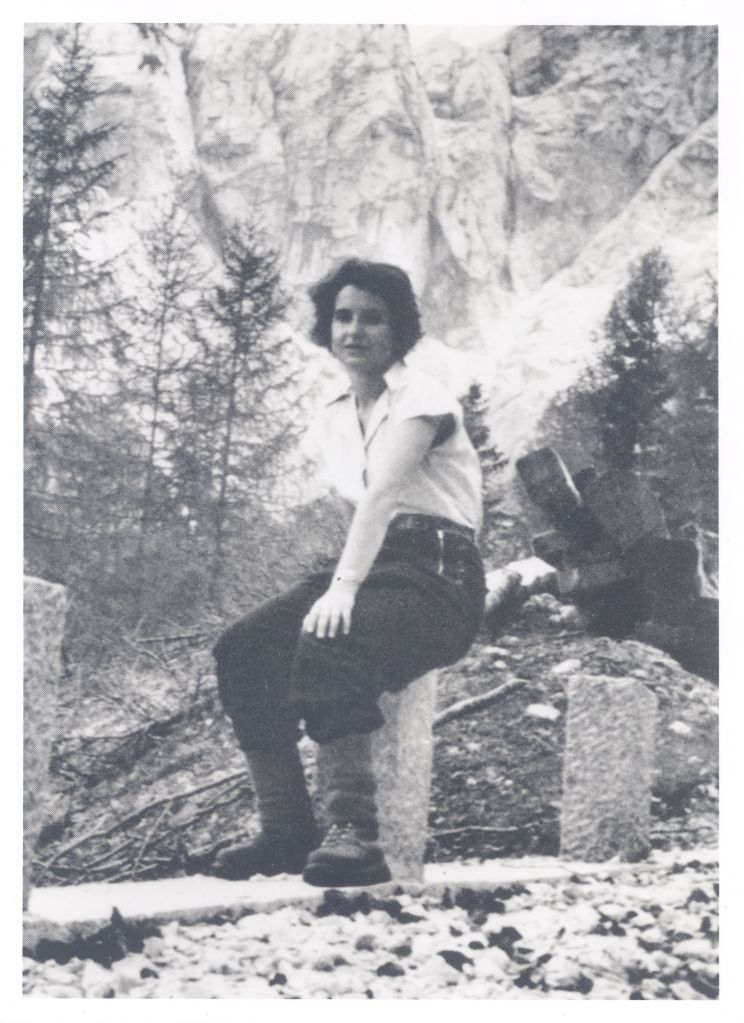
Science and everyday life cannot and should not be separated. Science, for me, gives a partial explanation of life. In so far as it goes, it is based on fact, experience, and experiment. . . . I agree that faith is essential to success in life, but I do not accept your definition of faith, i.e., belief in life after death. In my view, all that is necessary for faith is the belief that by doing our best we shall come nearer to success and that success in our aims (the improvement of the lot of mankind, present and future) is worth attaining. Rosalind Franklin in a letter to Ellis Franklin, ca. summer 1940
Pictured on the right side: Rosalind Franklin mountain climbing in Norway (Franklin was an avid hiker and traveler who spent most of her vacations hiking in various parts of Europe.)
Scientific inquiry and everyday life cannot — and should not — be separated. My work asks how scientific practices offer partial but powerful ways of making sense of the world: grounded in experience, experiment and careful attention, and inseparable from human values and responsibilities.
It begins with Newtonian methodology (Here you can find my dissertation on Newton’s concept of mathematical force). Where the standard reading treats episodes like the rotating bucket or the two globes as arguments about absolute space, I read them as procedural experiments in the art of measurement. What Newton develops is a general method for constructing quasi-isolated systems— domains stable enough that quantities like force and orbital deviation become tractable, and where approximation is a constitutive feature of inquiry rather than a failure of it. Scientists do not find systems; they build them, through idealisation, measurement and constraint, in order to render complex phenomena intelligible and practically actionable.
That question carries into the sciences we have now. In neuroscience and artificial intelligence, work on large-scale brain networks, probabilistic calibration and risk assessment shows how scientific representations shape not only explanation but judgment and responsibility. In environmental philosophy and climate ethics, practices of modelling, measurement and epistemic attention emerge as ethically significant ways of relating to the living world.
Across these domains I treat science as a situated human endeavour: one that does not offer final answers, but that matters because understanding the world we inhabit cannot be separated from caring for it.
Women and the making of natural philosophy
A continuing strand concerns women who did natural philosophy and the conditions under which their authority was granted or withheld —especially Emilie Du Châtelet and Laura Bassi. This is not a separate research area. The question of what has to be in place before a claim counts as knowledge is the same question, asked about people rather than about systems.
BOOK (In progress)
Constituting Systems — monograph
The book asks how a portion of the world becomes a system for purposes of inquiry. Nothing in nature arrives pre-packaged with a boundary, yet every measurement and every law is about something bounded. The book argues that constituting a system is an epistemic achievement in its own right, one that precedes measurement, idealization, and the application of laws. Its central strategy is what I call quasi-isolation: not the elimination of outside influence, but the construction of arrangements in which the interactions that matter are stabilized enough for a theoretical relation to become usable. Interference is not excluded but budgeted — reduced, held constant, corrected, or monitored through the residuals it leaves behind. The book follows the problem from Galileo’s inclined plane and Descartes’s plenum through Huygens’s clocks to Newton’s mechanics and optics, and then into eighteenth-century lecture rooms and perturbative astronomy.
Publications
1. Berkeley and Newton (2022), The Oxford Handbook of Berkeley, ed. Samuel Rickless.
Examines Berkeley’s engagement with Newtonian mechanics, clarifying how Berkeley accepts the mathematical framework of force while resisting its metaphysical interpretation. The paper situates Berkeley as a subtle methodological critic rather than a simple opponent of Newtonian physics.
2. Newton’s Example of the Two Globes (2023). In Chr. Smeenk and M. Stan (eds), Theory, Evidence, Data: the Philosophical Legacy of George E. Smith, Boston Studies in Philosophy and History of Science, vol. 337. Springer.
Reconstructs the rotating globes experiment as a conceptual and methodological device for isolating relational motion. Argues that the example functions as a controlled thought experiment for constructing measurable rotation rather than as a direct proof of absolute space.
3. From Endeavor to Instrument in Newton’s Early Dynamics (2025). The Journal of Early Modern Studies, Volume 14, Issue 2, Preprint: https://philsciarchive.pitt.edu/31077/
Before Newton, the “endeavour to recede from the centre” was something you could describe but not measure. Between the Waste Book and On Circular Motion (1669), Newton drops the mechanical scaffolding of a body constrained inside a cylinder for a purely geometrical magnitude — deviation from the tangent in equal times — and uses it to compare the Earth’s rotation, gravity at its surface, and the Moon’s orbit. A model that does not merely represent motion, but constructs the scale on which motion can be measured.
Under Review
I am happy to share drafts of manuscripts under review or in preparation—just send me an email: monicadriana.solomon@gmail.com
The Art of Quasi-Isolation: How Systems Are Made Measurable
Accounts of measurement usually begin with a quantity, an indicator, and a rule linking the two. This paper argues that they start one step too late. Before anything can be measured, a system has to be built in which that link holds steady — quasi-isolation: arrangements whose relevant causal interactions are stabilised enough to support inference, while remaining embedded in a wider physical world. Four cases from the Principia — the bucket, the two globes, the pendulum experiments, the planetary system — show the strategy at work. Measurement turns out to be constructive: its objects must be constituted before they can be indicated.
Mechanism and Difference-Making in the Newton-Hooke Exchanges
Philosophers of science distinguish two ways of explaining: exhibiting the productive process that brings a phenomenon about, or exhibiting what it depends on. That distinction tracks a recurring asymmetry in the letters Newton and Hooke exchanged in 1672 and 1679–80. Hooke keeps pressing for a physically conceivable process; Newton increasingly lets experimentally stabilised dependencies and mathematically articulated rules of generation carry the explanatory weight without one. It goes some way to explaining why the two men kept talking past each other — and suggests that dependency-based explanation has far deeper roots in exact science than we usually assume.
Beyond the Center of the World: Laws, Interaction, and the Construction of a Planetary System
The early modern problem of bodies asked what makes a collection of parts into a single body. This paper poses its successor — the problem of systems: under what conditions can a plurality of bodies be treated as a single unit of dynamical analysis? Newton’s answer, it argues, sits not in the laws of motion but in their corollaries, and first appears, still insecure, in the Copernican Scholium of 1684–85, where the traditional search for a privileged centre of the world gives way to a dynamical procedure. The Scholium outran its own foundations: an episode of constitution before warrant, in which the laws supplied conditions for treating a collection as a system before Newton could justify those conditions.
Function Before Ontology: Absolute and Relative Motion from De Motu to the Scholium
Newton’s distinction between absolute and relative motion is usually read as a claim about what exists. This paper argues it was introduced to do a job. It first appears not in a metaphysical treatise but in a scholium to a working mathematical tract, at exactly the point where referring projectile motions on a rotating earth requires it — and once the working role is visible, the Scholium’s notorious tensions turn out to be features of a method rather than defects of an ontology.
In preparation
Parts Given and Parts Drawn: Grounding Equilibrium in Descartes and the Early Newton
This paper reads Descartes’s account of fluid equilibrium in Principles II.55–63 as addressing a problem of causal delimitation: how can an interaction be bounded so that equilibrium or motion may be assigned to specified causes? Descartes generalizes from two idealized circulations to the complex motions of an actual fluid without fully warranting their dynamical equivalence. Read alongside Newton’s hydrostatical constructions in De gravitatione, this difficulty reveals a methodological dimension of Newton’s criticism of Cartesian physics. Newton’s geometrical constructions supply explicit conditions under which selected portions of matter may be treated as equivalent and their effects assigned to determinate causes.
Newtonian mechanics and the action-reaction principle (commissioned)
A conceptual and historical analysis of Newton’s Third Law as a foundational measuring principle for interaction. Explores how reciprocal forces structure coupling, symmetry, and physical individuation. (for The Comprehensive Philosophy of Science volume (Elsevier), edited by Sven Ove Hansson (2027))
Émilie Du Châtelet and the Philosophy of Newtonian Science (commissioned)
A critical review of recent scholarship on Du Châtelet, focusing on her role in the transmission of Newtonian mechanics, metaphysics, and methods of scientific explanation.
From Hypotheses to Principles: Isaac Barrow and the Methodological Foundations of Newtonian Science of Newtonian Scientific Method
Reconstructs Isaac Barrow’s role in shaping the functional distinction between speculative hypotheses and axiomatic principles. Interprets Newton’s hypotheses non fingo as the public application of an inherited epistemology of certainty.
Knowing How to Depend Well: Du Châtelet, Maupertuis, and the Formation of Philosophical Competence
Du Châtelet’s letters to Maupertuis are usually cited as evidence that a leading French Newtonian taught her mathematics. This project aims to show something philosophically richer: the formation of competence itself. The early correspondence documents a recognisable pedagogical practice — explanation, assigned work, independent performance, correction, a new task — while also showing Du Châtelet constructing the conditions of her own education, since no institution would supply them. By 1737 the relation has changed: Maupertuis is no longer the source and judge of tasks but one reader among several whose claims she can assess. The case suggests that epistemic agency is not independence from others. Competence consists partly in knowing how to depend well — whom to ask, how to read correction, and when another’s authority should cease to settle the question.
In Collaboration
Laura Bassi: Scientific Authority, Networks, and Popularisation.
Collaborative project with a colleague at Yale aiming at the first comprehensive English-language study of Bassi. Will provide translations of Bassi’s Latin theses and key writings, situate her work within Newtonianism, experimental physics and anatomy, and analyse her as a pioneering figure of women’s scientific authority, institution-building and public engagement.
How brain networks are individuated (philosophy of cognitive science)
Reframes the philosophical significance of the Default Mode Network by shifting attention from neural overlap to cognitive kind individuation. Argues for model pluralism across neural, computational, and psychological levels.
Truth, probability, and calibration in artificial intelligence (philosophy of risk & AI)
Analyzes probabilistic calibration as a bridge between machine optimization and human epistemic norms. Investigates whether calibrated confidence represents frequency, rational belief, or epistemic honesty.

